NEARAuth
A private identity for every signup — with a password vault and a tamper-evident audit trail.
Overview
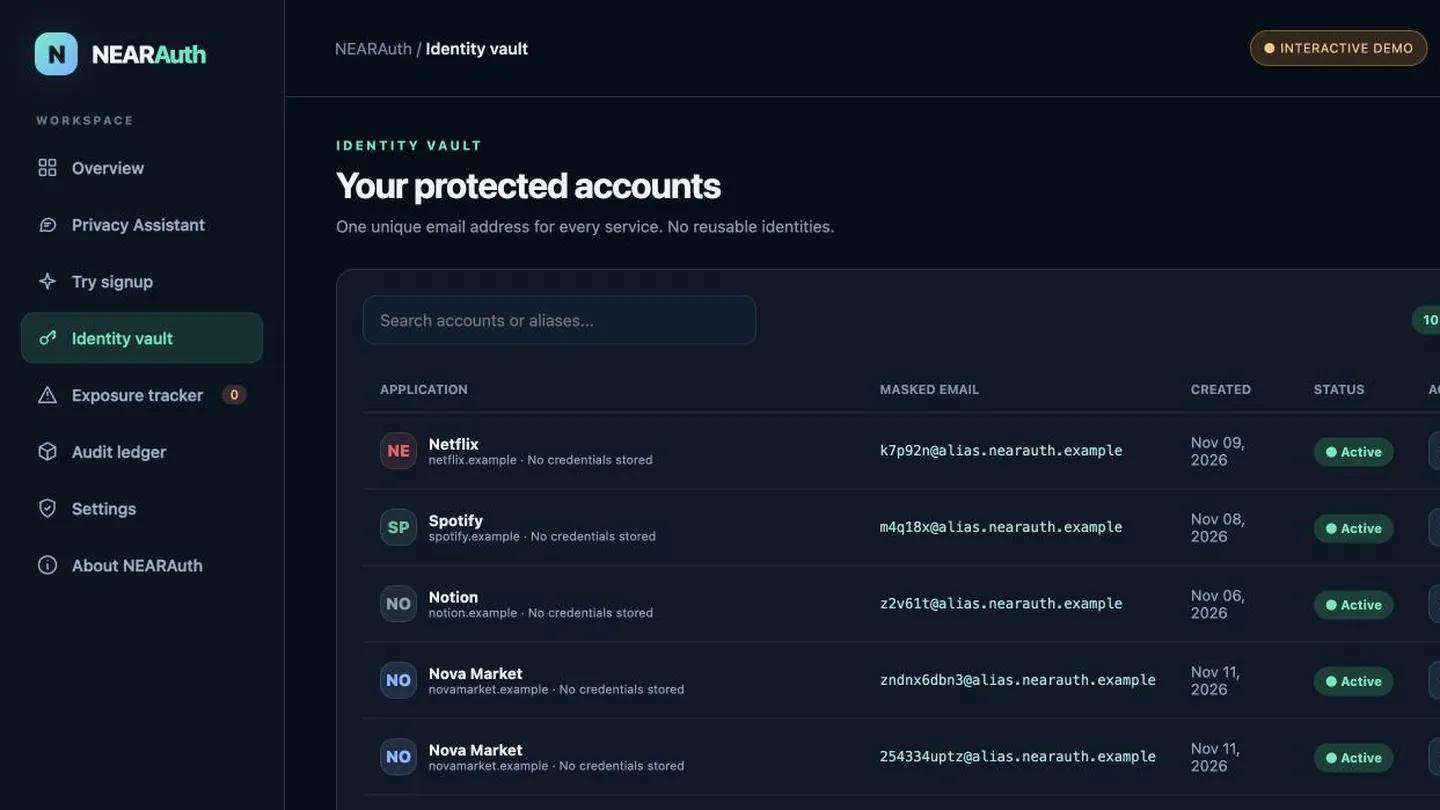
NEARAuth makes the real email address something you never give out. At signup, the extension fills a unique alias and a generated password; credentials go into a local encrypted vault; and when mail reaches an alias from a sender it was never given to, the exposure engine flags who shared it, with evidence. Every event is hashed into Merkle batches and their roots are anchored to a NEAR smart contract, so the history can't be quietly rewritten. Built at the NEAR Private AI Hackathon NYC (Build City × NEAR Legion), November 11, 2026, and extended after the demo with a policy-guarded privacy assistant.
The problem
Every signup hands a company your real email address, which then gets sold, leaked, or shared — and you rarely find out who did it.
My contribution
- Created the product and was its primary engineer (32 of 42 commits): the extension, vault, exposure engine, NEAR contract, and privacy-assistant agent.
- Built it with a hackathon team — teammates contributed end-to-end tests and the demo video.
- Set the security bar: no plaintext secrets, human approval before any account action, and nothing claimed that wasn't verified.
Architecture
How it fits together
- A Manifest V3 Chrome extension and a static dashboard share one library: alias and password generation, an AES-256-GCM vault (PBKDF2-SHA256, 600,000 iterations), exposure detection, and Merkle batching.
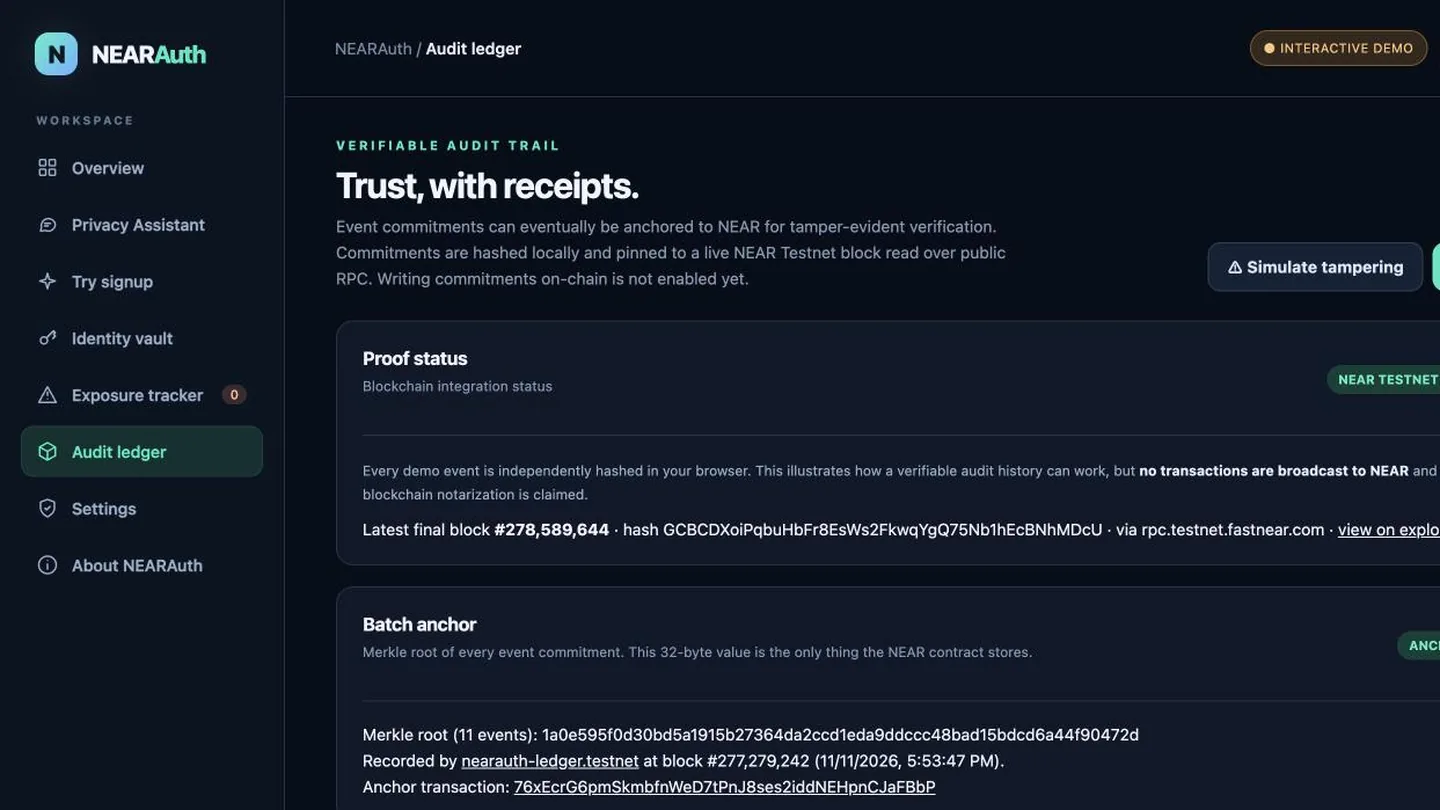
- A Rust smart contract (near-sdk) stores only Merkle roots; it is deployed to NEAR Testnet and anchored through a GitHub Actions workflow.
- A separate LangGraph privacy assistant runs request → deterministic policy → human approval → execute → verify → receipt, with Postgres/pgvector memory and an optional local model for intent classification.
Technology
Capabilities & validation
Implemented capabilities
- Signup detection that fills a unique alias and a strong generated password
- Encrypted local credential vault with auto-lock
- Exposure engine that names the likely leaker, with evidence and a confidence score
- Alias providers: addy.io and SimpleLogin adapters, plus a demo provider
- Merkle-batched audit trail anchored to a NEAR Testnet contract, with tamper detection
- Privacy assistant with policy checks and human approval before any action
Validation & evidence
- About 85 automated tests: 53 unit, 26 agent, 6 Rust contract, plus browser end-to-end specs
- Four CI workflows, including contract build and testnet deployment
- Contract live on NEAR Testnet (nearauth-ledger.testnet) with recorded anchor transactions
- Honest status: a demo prototype — alias forwarding is verified against mocked providers, and the security model is unaudited
Sources for this page
- README — hackathon, status, architecture
NEARAuth/README.md - Vault, generators, detection, Merkle
NEARAuth/extension/lib/ - Audit-ledger contract and testnet deployment record
NEARAuth/contracts/audit-ledger/ - Privacy assistant agent and tests
NEARAuth/agent/