Foundry — AI Software Factory
An agentic engineering system that turns a product brief into verified software.
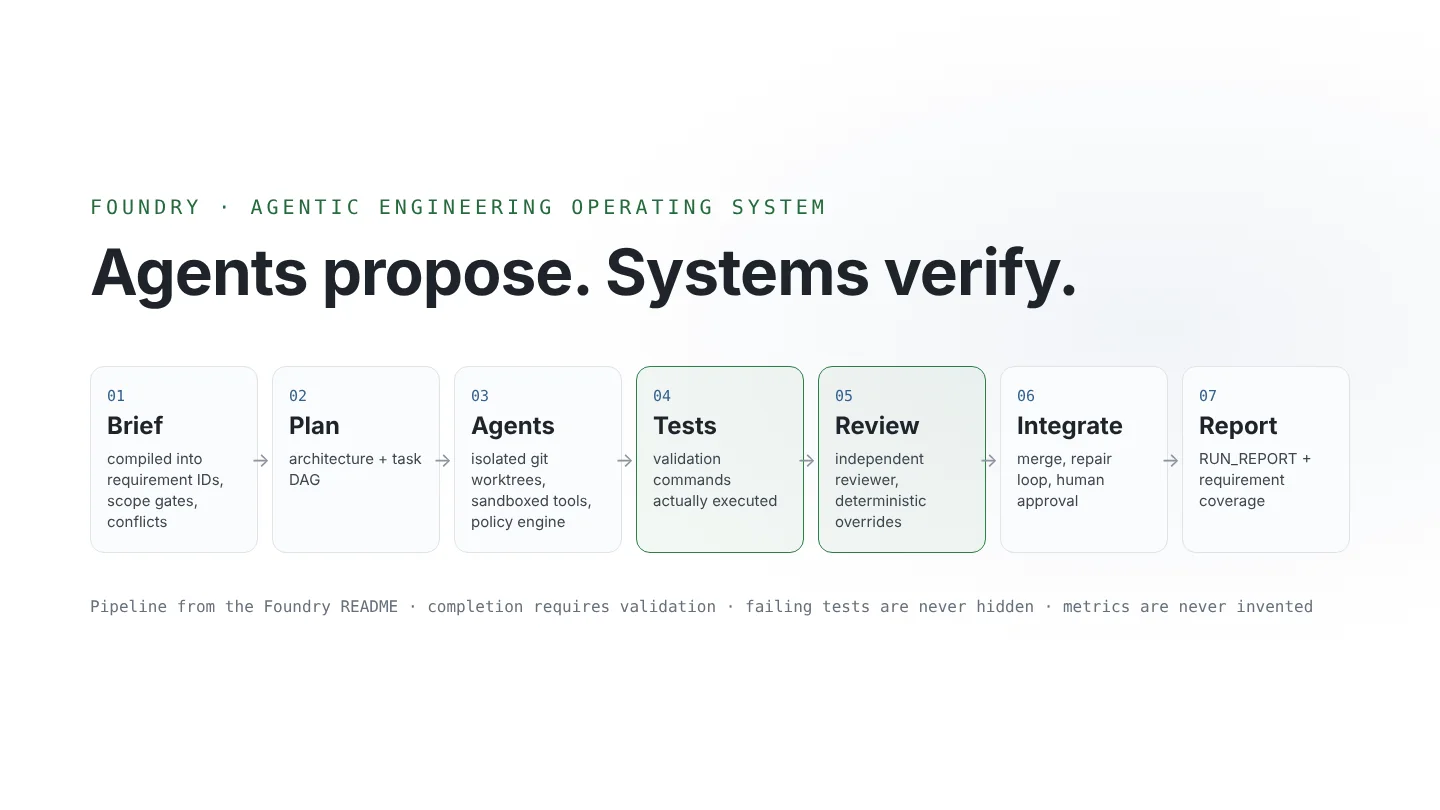
Overview
Foundry is the system Btechs uses to build software with AI agents without trusting them blindly. A brief — one sentence or a long specification — is compiled into numbered requirements and scope gates, planned into an architecture and task graph, and executed by specialist agents in isolated git worktrees under a deterministic policy engine. Completion requires validation: tests are actually run, test integrity is checked, an independent reviewer approves each change, and a run report traces every requirement to its coverage. KYAgent was delivered through Foundry.
The problem
AI coding agents write code fast but can't be trusted to finish: they skip tests, drop requirements, and approve their own work.
My contribution
- Designed and built the system: product specification, architecture, security model, and evaluation strategy.
- Defined the rules enforced in code — agents can't approve their own privileged work, LLMs can't override policy, failing tests are never hidden, metrics are never invented.
- Used it to deliver KYAgent for the MongoDB AI Hackathon.
Architecture
How it fits together
- A TypeScript monorepo: a CLI and control-plane server (HTTP + server-sent events) with durable state in node:sqlite and an append-only event log.
- A brief compiler, planner, and factory manager produce the task DAG; a model router sends routine work to smaller models and architecture, review, and security to the strongest, through Anthropic's API or the Claude Code CLI.
- Each task runs in its own git worktree and sandbox with stripped environment and timeouts; a React Factory Floor shows runs live or in replay.
Technology
Capabilities & validation
Implemented capabilities
- Brief compilation with requirement IDs, conflict detection, scope gates, and time-budget parsing
- Per-task git worktrees, sandboxed commands, and a deterministic policy engine
- Executed validation with test-integrity checks (no deleted tests, no weakened assertions)
- Independent review, merge integration, repair loops, and retries by failure class
- Human approvals, budgets, kill switch, crash recovery, and cost accounting
- RUN_REPORT with requirement coverage, and a live or replayed Factory Floor
Validation & evidence
- Milestone 4 — the vertical factory loop works end to end and is tested
- The specification's first factory test passes end to end, and six of Foundry's own evaluation scenarios run in CI against the real pipeline
- Delivered KYAgent: 35 test files, CI, and a public demo
- Honest status: visual QA, security scanners, and deployment targets are planned and reported as deferred, never claimed
Sources for this page
- Foundry README — status, pipeline, what is real and what is not
private repository - KYAgent README — delivered by Foundry
KYAgent/README.md